Boss RC-5 Loop Station Review: The Best All-Rounder Looper Pedal?
Boss RC-5 Loop Station review: 13 hours of stereo looping, built-in rhythms, and 99 memories — is this the best mid-tier looper pedal?
Music Gear Specialist Review Desk
Gear Research & Analysis
ℹ️ Affiliate Disclosure: Music Gear Specialist earns from qualifying purchases through Amazon and other partner links. This doesn't affect our recommendations—we only suggest gear we'd use ourselves.
As an Amazon Associate we may earn a commission from qualifying purchases made through links on this page, at no extra cost to you.
Looping has gone from a niche stage trick to a core creative tool for solo performers, songwriters, and home producers. The Boss RC-5 Loop Station (check current price on Amazon) sits in the sweet spot of Boss’s looper lineup — far more capable than the minimalist RC-1, but more affordable and compact than the flagship RC-600. It replaced the long-running RC-3 and brought a genuinely modernized feature set: built-in stereo rhythms, a small color screen, USB backup and WAV import, and 13 hours of recording time.
To be upfront about method: this is a research-based synthesis of Boss’s official specifications and the consensus of verified owners and professional reviewers — not a hands-on lab test. The goal is to cut through the marketing and help you decide whether the RC-5 fits the way you actually play.
Who the Boss RC-5 Is For
The RC-5 is aimed squarely at players who want one pedal that can do most of what looping asks of them:
- Singer-songwriters and solo performers who build full arrangements live — verse, chorus, layered guitar, and a rhythmic bed.
- Songwriters who use a looper to sketch parts, test chord progressions against a drum feel, and work out arrangements before hitting record in a DAW.
- Practice players who want a drum track to lock into, not just a click.
- Home studio owners who prefer a tactile, hardware workflow over software looping.
It’s less ideal for beatmakers who want multiple simultaneous, independently controllable tracks — that’s the territory of the tabletop RC-505 — or players who need the deep multi-tracking of the RC-600. The RC-5 is a single-track stereo looper, and that single decision shapes everything else about it.
If you’re shopping the category broadly, our Best Looper Pedal for Solo Performers roundup places the RC-5 next to its peers, and our guide to the Best Loop Pedals for Live Performance covers how loopers behave once a paying audience is watching.
Boss RC-5 Specs at a Glance
These figures come straight from Boss’s published RC-5 specifications:
| Feature | Spec |
|---|---|
| Phrase memories | 99 |
| Recording time | 13 hours (stereo) |
| Rhythm patterns | 16 built-in |
| Tracks | 1 stereo track (with undo/redo) |
| Inputs | 1/4” instrument (mono), 1/8” AUX (stereo) |
| Outputs | Stereo — L/MONO and R (1/4”) |
| Control jack | CTL/OUT (TRS) for optional footswitch |
| Computer I/O | Micro-USB (backup, restore, WAV import/export) |
| Power | 9V DC adapter (negative center) or 4× AA batteries |
The headline numbers — 99 memories and 13 hours — are more than any working guitarist will realistically fill. In practice, that ceiling means you stop thinking about storage and just play, which is exactly what a looper should encourage.
Where the RC-5 Genuinely Shines (Consensus Strengths)
Recording time you’ll never hit
Across owner reviews, the most repeated praise is simple relief: you don’t have to manage memory. The 13-hour stereo capacity means long sets, multiple songs, and experimental layers all live comfortably inside the box. You can store 99 separate phrases and recall them in performance order, which turns the RC-5 into a lightweight setlist machine for solo gigs.
Built-in rhythms change the workflow
This is the RC-5’s biggest real-world upgrade over the older RC-3. The 16 built-in rhythm patterns — adjustable in tempo and feel — give you an instant metronomic and musical bed to loop against. For practice, that’s invaluable; for solo performance, it lets a single guitarist fill out a groove without dragging a drum machine. Players repeatedly single out the rhythms as the feature that moved the RC-5 from “a looper” to “a performance tool.”
Sound quality and a sane USB workflow
The RC-5 is widely described as clean and quiet, with enough fidelity that loops don’t audibly degrade as you stack layers. Equally important is the micro-USB connection: you can back up your phrases to a computer, restore them, and import your own WAV files to use as loop material. That last point matters more than it sounds — it means you can pre-load a backing part, a found-sound texture, or a rehearsed arrangement and trigger it live, rather than rebuilding everything on the fly.
Boss build quality
It’s a recurring theme in owner feedback: the RC-5 feels like it will survive a decade of stomping. Boss’s metal-chassis, recessed-knob reputation holds here, and the three-footswitch layout is sturdy under a boot. For gigging musicians, “it won’t break” is not a trivial feature.
Honest Gripes and Limitations
A review that only lists strengths isn’t honest, so here’s where the RC-5 draws complaints.
It’s a single-track looper
The defining limitation: you get one stereo phrase. You can layer over it and use undo/redo, but you can’t, say, stop the guitar loop while the vocal loop keeps running, or independently mix multiple parts the way a multi-track looper allows. If your act depends on starting and stopping layers independently, you’ll outgrow the RC-5 fast — look at the RC-10R (two tracks) or RC-600 (six).
Menu diving and a small screen
The color screen is a step up from the RC-3’s bare numeric display, but it’s still small, and deeper functions — rhythm editing, memory naming, footswitch assignment — require menu navigation. On a dark stage this is a real friction point. Several owners note that configuring the pedal the way you want it is a “set it up at home, then don’t touch it” affair rather than something you tweak mid-set.
Rhythm realism and the lack of loop effects
The 16 rhythms are useful, but they’re tool-like patterns, not convincing drum-kit sounds — fine as a bed, not a feature you’d build a recording around. And while the RC-5 loops your tone faithfully, it has no built-in effects on the loops themselves (no reverb, delay, or filters applied post-capture). If you want ambient decay or filtered textures on your loops, you’ll need external pedals in the chain.
Learning the footswitch logic
The three-switch workflow (Record/Play, Stop, and a Track/TAPE switch) is powerful once learned, but new users frequently describe a learning curve around stopping loops cleanly and managing the play/stop behavior. It’s not insurmountable, but budget some time with the manual before your first gig.
Fitting the RC-5 Into Your Rig
Placement matters more than people expect with a looper. The conventional wisdom, covered in detail in our Pedalboard Signal Chain Order guide, is to put a looper last in the chain — after your drives, modulation, and time-based effects — so the loop captures your fully processed tone. That way a looped chord with delay and reverb plays back exactly as you heard it. (If you’re newer to how effects interact, our Guitar Pedals Explained primer is a good companion read.)
A couple of practical notes:
- Power. The RC-5 runs on a standard 9V DC negative-center supply (Boss PSA-series and most isolated pedalboard supplies) or four AA batteries. If you’re unsure whether your current supply can handle it cleanly alongside the rest of your board, our article on whether you can use any power supply with a pedalboard walks through the pitfalls — noise and shared-current issues are the usual culprits.
- Stereo. With stereo outputs, you can send your loop to two amps or a stereo mixer for a wider, more immersive stage sound — a real advantage over mono loopers at this price.
How It Compares to the Alternatives
- vs. Boss RC-3: The RC-5 is the direct successor and improves on the older pedal in nearly every way — better sound, the color screen, USB WAV import, and the built-in rhythms the RC-3 lacked. Unless you’re buying used at a steep discount, the RC-5 is the pick.
- vs. Boss RC-10R: The RC-10R adds a second track and a more sophisticated rhythm section, at a higher price. Choose it if independent track control matters to your act.
- vs. Boss RC-505 / RC-600: These are multi-track flagships for players who need several layers running at once. They cost substantially more and are larger; overkill for most guitarists.
- vs. TC Electronic Ditto and similar mini-loopers: The Ditto is cheaper, simpler, and tiny — great if you just want basic layering with no rhythms or screen. The RC-5 justifies its price with memory, rhythms, and USB.
- vs. Electro-Harmonix 720: A strong single-track alternative with its own effects, but the RC-5’s recording time and rhythm features are the differentiators.
The Verdict
The Boss RC-5 Loop Station earns its reputation as the default mid-tier looper for good reason. It pairs essentially unlimited recording time, useful built-in rhythms, clean sound, and a sensible USB workflow in a road-tough box — all at a price that makes sense for working musicians. Its weaknesses (single-track operation, a small screen, menu-driven setup) are real but easy to predict: if you know you only need one loop and you’re willing to configure the pedal once and leave it, those limitations barely register.
For singer-songwriters, solo performers, songwriters, and practice-focused players, the RC-5 is one of the safest, most capable purchases in the pedal world. For multi-layer performers who need independent track control, look one or two rungs up the Boss ladder.
Buying notes (what to check before you click)
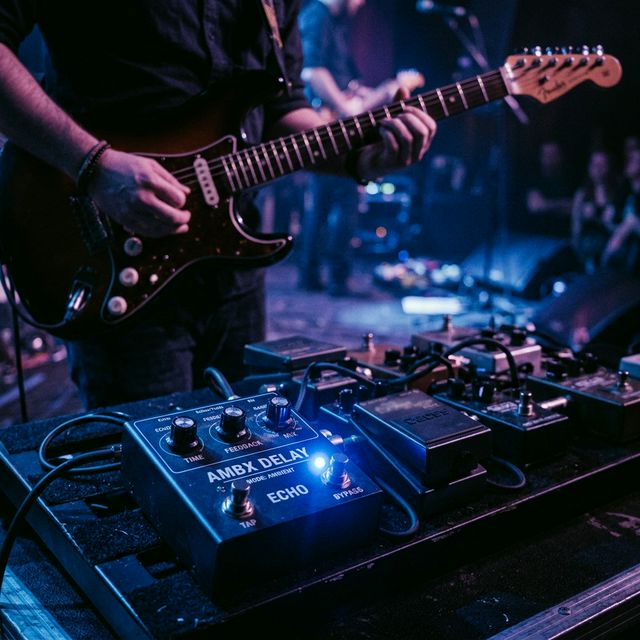
Pedalboard checks, not a staged shoot-out:
- Confirm RC-5, not RC-1 / RC-10R / RC-500. One stereo phrase plus rhythms is the whole product.
- You need a 9V center-negative supply or AAs. Isolated outputs matter on a crowded board — see can you use any power supply on a pedalboard? and the pedal power guide.
- Put it last in the chain so loops capture delay/reverb. Order notes: pedalboard signal chain.
- If you already know you need independent guitar and vocal loops, skip this and read best looper pedals instead.
- Sibling pedal reads: Ibanez TS9 review · pedals hub · best loop pedal for solo performers.
To hear how the RC-5 sounds and flows in real use, watch official Boss demos and owner walkthroughs on YouTube — seeing the footswitch choreography is the fastest way to tell whether its workflow clicks for you.
Boss RC-5 Loop Station: Frequently Asked Questions
Is the Boss RC-5 good for beginners? Yes, with a caveat. Basic record/play/stop looping is approachable quickly, and the built-in rhythms make practice more musical than practicing to a click. The caveat is that the deeper menus take some time to learn, so set aside an evening with the manual before your first performance.
Does the Boss RC-5 have drums? It has 16 built-in rhythm patterns you can loop and perform against, with adjustable tempo and feel. They’re practice-and-performance beds rather than full drum-kit sounds.
What’s the difference between the RC-5 and the RC-3? The RC-5 is the successor. It adds the color screen, built-in rhythms, improved sound, and USB backup plus WAV import — features the older RC-3 lacked — while keeping the same generous recording-time philosophy.
Can the RC-5 run on batteries? Yes. It runs on a standard 9V DC adapter or four AA batteries, so it works for street performance or anywhere mains power isn’t available.
Can I save and load my loops to a computer? Yes — via the micro-USB port you can back up phrases, restore them, and import your own WAV files to use as loop material.
— Music Gear Specialist Review Desk
Quick Verdict
Rating: 4.5 / 5
The default mid-tier looper: Battery-like Boss build, sensible I/O, and 13 hours of stereo looping. Single-track operation is the limit you accept at this price.

Music Gear Specialist Review Desk
Research-based reviewsResearch-based reviews · Manufacturer specs · Verified owner feedback
We review guitars, amps, pedals, and recording gear the honest way: spec sheets, published measurements, and the collected experience of working musicians and verified owners.