How Long Does It Take to Learn Guitar? (Honest Timeline)
Can I learn guitar in 3 months? Yes, if you define the goal clearly. See a realistic 90-day guitar plan, practice schedule, and beginner timeline.
Music Gear Specialist Review Desk
Gear Research & Analysis
ℹ️ Affiliate Disclosure: Music Gear Specialist earns from qualifying purchases through Amazon and other partner links. This doesn't affect our recommendations—we only suggest gear we'd use ourselves.
“How long will it take?” is the first question every aspiring guitarist asks, and the answer you usually get is frustratingly vague. “It depends” isn’t helpful when you’re deciding whether to invest hundreds of hours and hundreds of dollars into a new skill.
So here is the honest answer: your first 3 months should be judged by songs, chord changes, rhythm, and consistency, not by whether you sound like a finished guitarist.
Can I learn guitar in 3 months? Yes, if “learn guitar” means playing beginner songs, switching common open chords, following basic tabs, and keeping a simple rhythm. No, if it means clean barre chords in every key, fast solos, improvisation, or confident live performance.
TL;DR: With 30 minutes of daily practice, you can play basic songs in 1-3 months, sound more natural in 6-12 months, and reach a confident intermediate level in 1-2 years. Fender has publicly reported that most new players leave early, so the first 90 days matter because they build the habit that keeps you playing.
Can I Learn Guitar in 3 Months?
Yes, you can learn guitar in 3 months if your goal is to play real songs, switch common open chords, keep basic rhythm, and understand simple tablature. Three months is enough time to become a functional beginner, not an advanced player.
With 30 minutes of focused practice most days, a realistic 3-month result looks like this:
| Skill | Realistic 3-month outcome |
|---|---|
| Chords | 8-10 open chords, including G, C, D, Em, Am, E, A, and Dm |
| Chord changes | Smooth changes between common beginner progressions |
| Rhythm | 3-4 reliable strumming patterns with steady timing |
| Songs | 5-10 complete beginner songs played start to finish |
| Reading | Basic tabs, chord charts, and song sheets |
| Technique | Cleaner fretting, less string buzz, basic calluses |
What you should not expect in 3 months: fast solos, clean barre chords in every key, advanced fingerstyle, confident improvisation, or stage-ready playing. Those usually take longer because they require hand strength, timing, ear training, and repetition.
The best way to learn guitar in 3 months is to narrow the target: pick one style, one practice resource, and five songs you actually want to play. Jumping between random lessons slows progress more than a modest practice schedule does. Acoustic starters should also choose a comfortable first instrument; our beginner acoustic guitar advice for 2026 explains the action, body-size, and accessory checks that matter most.
The Realistic Timeline
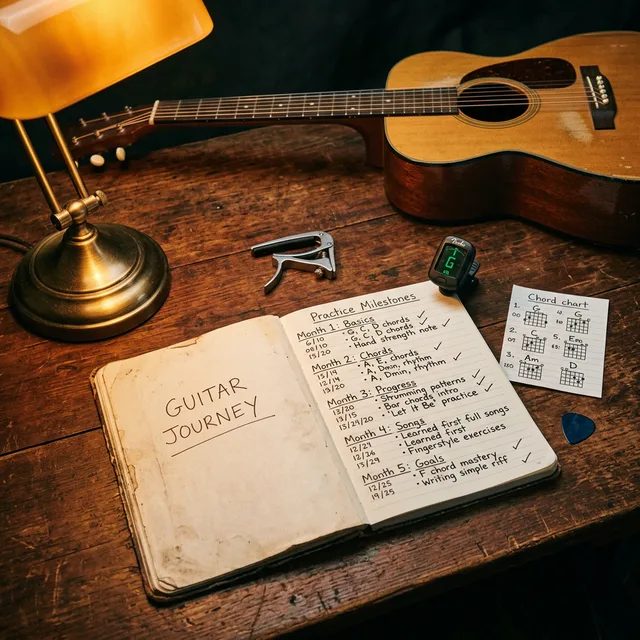
Month 1: The Foundation (and the Frustration)
What you’ll learn:
- 4-6 basic open chords (G, C, D, Em, Am, E)
- Simple strumming patterns (down-down-up-up-down-up)
- How to read guitar tablature
- Basic finger positioning and fretting technique
What it feels like: Honestly? Painful. Your fingertips will hurt for the first 2-3 weeks until calluses form. Chord changes will be slow and clumsy. You’ll hear buzzing and muted strings constantly. This is completely normal, every guitarist who ever lived went through this phase.
The milestone: Playing a simple 2-chord song all the way through without stopping.
The first month is where many beginners quit because the guitar still feels physically awkward. The single best piece of advice is simple: learn songs you love immediately, even simplified versions. Playing recognizable music, however imperfectly, is what keeps you motivated through the frustrating early weeks.
Months 2-3: Songs Start Happening
What you’ll learn:
- 8-10 open chords, including minors and sevenths
- Smooth chord transitions (under 2 seconds between any two chords)
- 3-4 strumming patterns
- 5-10 complete songs
- Basic fingerpicking introduction
- Pentatonic scale basics
What it feels like: Things click. Calluses have formed, finger pain is gone, and chord changes start becoming automatic. You can play along with recordings at slower tempos. Friends and family can recognize the songs you play.
The milestone: Playing a full song start-to-finish without stopping to reposition your fingers.
Months 4-6: Real Music Starts
What you’ll learn:
- Barre chords (F and Bm, the two that trip everyone up)
- Power chords and palm muting
- Basic lead concepts (pentatonic scale in position)
- Fingerpicking patterns
- Capo usage for different keys
- Reading and playing from tabs independently
What it feels like: A significant jump in capability. Barre chords unlock the entire fretboard, suddenly any song in any key is within reach. You start developing stylistic preferences and gravitating toward certain genres.
The milestone: Playing a song with barre chords smoothly, or playing your first recognizable riff or solo.
Months 6-12: The Intermediate Transition
What you’ll learn:
- Extended chord voicings (7ths, sus2, sus4, add9)
- Multiple scale positions across the fretboard
- Improvisation basics over chord progressions
- Hammer-ons, pull-offs, bends, slides
- Basic music theory (intervals, the number system)
- Playing with other musicians
What it feels like: You’re genuinely playing guitar. You can learn most songs from a tab within a few days. You have a developing sense of your own style. People start asking you to play at gatherings. You’re thinking about getting a better guitar or amp.
The milestone: Improvising a simple solo over a backing track, or playing a complete set of 5-10 songs without music in front of you.
Years 1-2: Solid Intermediate
What you can achieve:
- Fluid barre chords everywhere on the neck
- Comfortable improvisation in multiple keys and positions
- Ability to learn new songs quickly by ear
- Developing a recognizable personal style
- Possible first band experience or open mic performance
- Understanding of music theory that informs your playing
What it feels like: Guitar is part of who you are now. You pick it up daily without thinking about “practicing”, you’re just playing. You have strong opinions about tone, gear, and technique. You start noticing things in professional recordings you couldn’t hear before.
The Practice Equation
The timeline above assumes 30 minutes of focused daily practice. Here’s how practice duration affects the timeline:
| Daily Practice | Reach “Intermediate” | Total Hours |
|---|---|---|
| 15 minutes | 3-4 years | ~400 hrs |
| 30 minutes | 1.5-2 years | ~400 hrs |
| 1 hour | 9-12 months | ~400 hrs |
| 2 hours | 5-7 months | ~400 hrs |
Notice the total hours are roughly the same, it’s consistency, not intensity, that matters. Fifteen minutes daily beats two hours on Saturday because muscle memory builds through repetition, not marathon sessions.
What “Focused Practice” Actually Means
Not all practice is equal. Here’s the difference:
Productive practice (deliberate):
- Working on a section that challenges you
- Practicing chord transitions you can’t do smoothly yet
- Playing along with a metronome at a speed that pushes you
- Learning new songs that introduce unfamiliar techniques
Unproductive practice (noodling):
- Playing the same three songs you already know
- Improvising with the same familiar patterns
- Playing without a specific goal or focus
- Watching YouTube tutorials without picking up the guitar
A focused 30-minute session with clear goals produces more improvement than 2 hours of aimless noodling.
The guitarists who improve fastest share one habit: they practice what they cannot do yet, not only what already feels comfortable. Comfortable playing is performing, not practicing. Real practice feels slightly uncomfortable because you are working at the edge of your ability.
The Biggest Obstacles (and How to Beat Them)
Obstacle 1: Sore Fingers (Month 1)
Solution: Play through it (within reason). Calluses form in 2-3 weeks. Use lighter gauge strings (.009s) to reduce the pain. Take short breaks during practice but don’t skip days.
Obstacle 2: F Barre Chord (Months 3-5)
Solution: The F chord is the most notorious learning wall. Start with the “cheater F” (only bar the first two strings), then gradually build to the full barre. Practice pressing the barre for 10 seconds, releasing, then pressing again, this builds specific finger strength.
Obstacle 3: The Plateau (Months 8-14)
Solution: Every guitarist hits a plateau where improvement seems to stall. The fix: change your practice routine. Learn a completely different genre, take a lesson focusing on technique, learn music theory, play with other musicians, or set a specific performance goal (learn a particular solo, play at an open mic).
Obstacle 4: Comparing to Others
Solution: Social media shows polished performances, not the thousands of hours behind them. Compare yourself to yourself one month ago, that’s the only meaningful comparison.
Your Action Plan
- Get a guitar, acoustic for singer-songwriter style, electric for rock/blues/metal
- Get a tuner, app (free) or clip-on ($15)
- Choose one learning resource, Justin Guitar (free), Fender Play ($10/mo), or local lessons ($30-$60/hr)
- Practice 30 minutes daily, set a timer, have a plan
- Learn songs you love from day one, motivation beats methodology
- Join a community, Reddit r/guitar, local jam nights, or a friend who plays
90-Day Beginner Guitar Plan
Use this simple plan if your specific goal is to learn guitar in 3 months.
Days 1-30: Make Guitar Feel Normal
Practice daily for 20-30 minutes. Learn G, C, D, Em, Am, and E. Spend most of the time changing between two chords at a steady tempo. End every session by playing a simple song, even if it is slow.
Days 31-60: Build Song Fluency
Add A, Dm, and basic seventh chords. Start using a metronome. Pick three songs and practice them until you can play through mistakes without stopping. This is also the right time to learn basic tab reading.
Days 61-90: Sound Like Music
Tighten rhythm, clean up buzzing strings, and record yourself weekly. Add one harder song that forces a new skill, such as a simple fingerpicking pattern, a basic riff, or a partial barre chord. By day 90, you should have a small set of songs you can play start to finish.
If you want a structured self-study path, pair this timeline with our how to learn guitar at home without a teacher roadmap.
Buying notes (what to check before you click)
Listing checks Amazon copy skips. Starter-guitar and tuner street prices on this page are a research snapshot, not a live offer.
Use-case fit
- Acoustic singer-songwriter, 30 minutes a day: a playable concert or dreadnought, not an $89 mystery-brand kit. Start with best acoustic guitars for beginners. Search the actual FG800, not a “starter pack” that hides a warped neck: Yamaha FG800.
- Electric rock or blues for the first 90 days: Pacifica or Squier Affinity plus a clip-on tuner, not a 100-watt half stack. See best beginner electric guitars and the Yamaha Pacifica 112V review.
- Shared walls: a practice amp or headphones, not a 1x12 cranked in a bedroom.
- Guitar left out so the habit sticks: a stand is cheaper than a snapped headstock. Chooser: how to choose a guitar stand.
When to skip / when to buy
- Skip a $1,200 guitar before you have five songs. The first 90 days fail on sore fingers and skipped days, not on a missing flame-maple top.
- Skip a $400 pedalboard before G-to-C takes under two seconds.
- Skip leaning the new guitar on a chair or amp. That is how headstocks die in month one.
- Buy a clip-on tuner on day one. Buy lighter strings (.009 electric / light acoustic) if month-1 pain is the quit risk.
Listing checks the product title usually omits
- Acoustic vs electric as a first guitar. A “beginner guitar kit” photo is not a setup.
- Pacifica 112V vs a no-name S-style with the same silhouette.
- Clip-on tuner vs pedal tuner. You do not need a pedal tuner in month 1.
- Action height and whether anyone set the guitar up. Many $150 kits ship unplayable.
- Hum that is electrical, not student technique: if the amp drones with the guitar volume rolled off, that is amp hum, not a “bad student.”
Next reads: guitars hub · best music gear roundups.
Sources
- Fender newsroom: Fender releases new study on the state of guitar players
- Music Gear Specialist beginner acoustic buying advice
- Music Gear Specialist basic guitar chords guide
Keep Reading
- Basic Guitar Chords Every Beginner Needs, start with these chords
- How to learn guitar at home without a teacher, self-study path
- Best Acoustic Guitars for Beginners, our top picks for new players
- Best Electric Guitars for Every Budget, ready for electric?
- Yamaha Pacifica 112V review, a common first electric
- Epiphone Les Paul Standard ’60s review, if you already know you want humbuckers
- Guitar Practice Routine, structure your daily practice
- How to Read Guitar Tabs, learn to read tabs in 15 minutes
- How to change guitar strings and how to tune a guitar

Music Gear Specialist Review Desk
Research-based reviewsResearch-based reviews · Manufacturer specs · Verified owner feedback
We review guitars, amps, pedals, and recording gear the honest way: spec sheets, published measurements, and the collected experience of working musicians and verified owners.