How to Choose a Fender Electric Guitar: Stratocaster vs Telecaster vs Jazzmaster
Compare Fender Stratocaster, Telecaster, and Jazzmaster models. Learn about pickup layouts, series tiers, bridge types, and find your perfect guitar.
Music Gear Specialist Review Desk
Gear Research & Analysis
ℹ️ Affiliate Disclosure: Music Gear Specialist earns from qualifying purchases through Amazon and other partner links. This doesn't affect our recommendations—we only suggest gear we'd use ourselves.
To choose the right Fender electric guitar, you must select between the contoured, three-pickup Stratocaster, the simple slab-body Telecaster, or the offset-body Jazzmaster. Each shape has unique pickup switching and bridge designs that produce distinct tones and playing experiences.
This is a research-desk chooser, not a Custom Shop bench. Factory, pickup layout, and bridge notes below come from Fender’s published series pages and the listing twins Amazon keeps collapsing into one silhouette. Music Gear Specialist Review Desk is not scoring a house fleet.
Executive Summary
Before purchasing your Fender electric guitar, evaluate these key elements:
- Stratocaster excels at comfort and clean versatility, utilizing a double-cutaway shape and three single-coil pickups.
- Telecaster offers direct plug-and-play simplicity and country/rock bite, using a solid hardtail bridge.
- Jazzmaster features a comfortable offset body design and mellow, wide single-coil pickups suited for alternative and surf genres.
- Pickup Layouts dictate tone. Traditional SSS layouts produce clean chime, while HSS layouts add a bridge humbucker for rock distortion.
- Manufacturing Locations divide the line. Mexican-made models (Player series) offer great value, while USA-made models (Professional II) feature elite craftsmanship.
How Do the Stratocaster, Telecaster, and Jazzmaster Compare?
Fender’s three primary body shapes represent different design philosophies and sonic signatures.
The Telecaster, introduced in 1951, is the simplest design. It features a solid slab body without contours, a hardtail bridge, and two single-coil pickups. The tone is famous for its bright treble “twang” in the bridge position and a warm, clear tone in the neck. Its simplicity makes it virtually indestructible. For a deeper head-to-head comparison, read our article on the Stratocaster vs Telecaster.
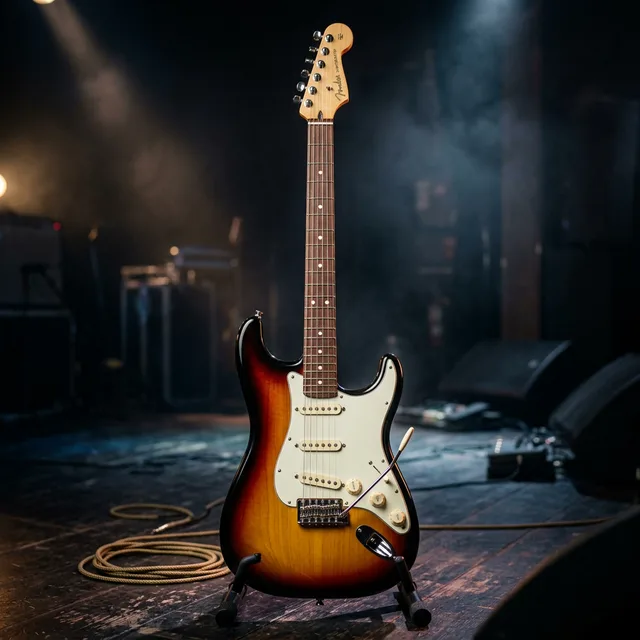
The Stratocaster, introduced in 1954, added body contours on the back and front to make the guitar rest comfortably against the player’s ribs. It features double cutaways for upper-fret access, three single-coil pickups, and a synchronized tremolo bridge. The Strat’s signature sound is glassy and scoop-midded, particularly in pickup positions 2 and 4, which combine the middle pickup with the bridge or neck.
The Jazzmaster, introduced in 1958, features an offset waist design. This offset body balances the weight perfectly when playing seated. It uses wider, flatter single-coil pickups that produce a warmer, more rounded sound compared to a Stratocaster. The Jazzmaster also features a complex dual-circuit wiring layout (Lead and Rhythm circuits) and a long, floating vibrato tailpiece popular in surf and indie rock.
Which Pickup Layout (SSS, HSS, or HH) is Right for You?
Fender offers its electric guitars with multiple pickup configurations, which affects the genres the guitar can handle.
- SSS (Single-Single-Single): This is the traditional Stratocaster layout. It uses three single-coil pickups. It provides unmatched clarity, chime, and glassiness. However, single-coils naturally produce a 60-cycle hum when exposed to interference or high-gain pedals.
- HSS (Humbucker-Single-Single): This modern layout replaces the bridge single-coil with a dual-coil humbucker. The humbucker cancels hum and produces a thicker, louder tone that is perfect for heavy rock distortion. This layout, found on many Fender Player Stratocaster models, is highly versatile.
- HH (Humbucker-Humbucker): This configuration uses two humbuckers. It removes the traditional single-coil glassiness completely, replacing it with a thick, mid-range punch similar to a Gibson. If you are comparing Fender’s humbucker designs to other major brands, read our guide on Fender vs Gibson.
If you want classic vintage tones, go with SSS. If you want to play a mix of clean pop and heavy rock, HSS is the ideal choice.
What Are the Differences Between the Player, Performer, and Professional II Series?
Fender organizes its lineup into distinct tiers based on price, hardware specifications, and manufacturing location.
The Player series (built in Ensenada, Mexico) is Fender’s entry-level standard line. These guitars feature alder bodies, maple necks, and modern Alnico pickups. They are professional-grade instruments that represent the best value in Fender’s catalog. The Fender Player Telecaster is a top seller in this tier.
The American Performer series is the entry point for USA-made Fenders (built in Corona, California). These models introduce Yosemite pickups, the Greasebucket tone circuit (which rolls off highs without adding bass mud), and vintage-style tuners.
The American Professional II series is the industry standard for working musicians. These USA-made guitars feature V-Mod II pickups, a contoured neck heel for upper-fret comfort, and a premium hard case. They offer exceptional fretwork and overall build consistency.
What Upgrades Do You Get in the Fender Ultra and Custom Shop Lines?
For players who want the absolute best hardware and finish options, Fender offers its premium tiers.
The American Ultra series features modern ergonomic upgrades. These guitars use compound-radius fretboards (10 to 14 inches) that are rounded near the nut for easy chording and flatter at the dusty end for soloing without bending notes out. They also feature Ultra Noiseless pickups, which eliminate 60-cycle hum while preserving single-coil tone, and locking tuners.
The Custom Shop represents Fender’s elite luthier division. These guitars are hand-crafted to historical specifications or custom ordered. They feature premium wood selection, custom-wound pickups, and varying levels of relic work (simulated age wear). They are expensive collector-grade instruments.
If you are trying to decide if these high-end lines are worth the money, check out our guide on are expensive guitars worth it.
How Do Hardtail, Synchronized Tremolo, and Offset Tremolo Bridges Compare?
The bridge type you choose affects your guitar’s tuning stability, string tension, and vibrato capabilities.
A hardtail bridge, standard on the Telecaster, mounts the strings directly through the back of the body. It has no moving parts. This provides excellent tuning stability, simple string changes, and maximum sustain. It is the best option if you do not want to use a whammy bar.
Fender’s synchronized tremolo, standard on the Stratocaster, uses springs inside the back of the body to balance string tension. This allows you to bend pitch down or up. While highly expressive, it requires a careful setup to prevent tuning slips. If you need assistance with string changes, read our guide on how to change guitar strings.
The offset tremolo, standard on the Jazzmaster, features a separate bridge and a long vibrato arm located far back on the body. This creates a shallower string angle, giving the guitar a loose, slinky feel and a subtle, smooth vibrato. However, the low break angle can cause strings to slip out of their bridge slots if you strum aggressively. Many players swap this for an aftermarket Mastery bridge to improve stability.
What Fretboard Woods and Neck Shapes Does Fender Offer?
The neck is your primary contact point with the guitar, and Fender offers distinct shapes and woods to match different hand sizes.
Fender uses Maple for its necks. For the fretboard, you will see two main choices:
- Maple: A light-colored wood that is lacquered. It has a smooth, glassy feel and projects a bright, snappy high-end tone.
- Pau Ferro or Rosewood: Darker woods left unlacquered. They have a natural, textured feel and absorb some high frequencies, offering a warmer tone.
For neck shapes, the Modern C is Fender’s standard profile. It is a thin, comfortable shape that fits most hand sizes. The Deep C (found on the Professional II) has slightly more shoulder, filling the palm more. The Augmented D (found on the Ultra series) is flatter in the center, facilitating fast lead playing.
How Does Scale Length and Body Wood Impact Fender Tone?
Scale length is the distance between the bridge and the nut. Fender’s standard scale length is 25.5 inches. This is longer than Gibson’s 24.75-inch scale. The longer scale increases string tension, giving Fender guitars their characteristic snappy, bright attack and clear note separation.
Fender primarily uses two body woods:
- Alder: A medium-weight wood with a balanced frequency response. It provides a clear mid-range and tight bass.
- Pine: Used on some vintage-style Telecasters, offering a bright, punchy tone.
- Mahogany: Used on select modern models, providing a warmer tone.
Most Fenders use Alder, which provides a neutral acoustic foundation that allows the pickups to shape the guitar’s voice.
Which Fender Guitar Model Is Best for Beginners and Students?
For a beginner, the simplicity of a Telecaster makes it the ideal starting point.
A Telecaster has no floating tremolo bridge, meaning it is simple to tune and stays in tune when you bend strings. The controls are simple: one volume knob, one tone knob, and a three-way switch. It is a reliable tool for learning the fundamentals of rhythm and lead playing.
If you are on a tight budget, look at Fender’s Squier line. The Squier Classic Vibe ’60s Jazzmaster offers vintage styling and hardware at a fraction of the cost of a Fender. For more budget alternatives, review our list of the best beginner electric guitar under $300.
FAQ
What is the difference between a Stratocaster and a Telecaster?
The Stratocaster has a contoured body with double cutaways, three single-coil pickups, and a synchronized tremolo bridge. The Telecaster features a slab body, two single-coil pickups, and a hardtail bridge, producing a simpler, brighter twang with more sustain.
Are Fender Player Series guitars made in the USA?
No, Fender Player Series guitars are manufactured in Fender’s factory in Ensenada, Mexico. They offer excellent build quality and professional-grade playability at a more affordable price than USA-made models.
Is the Jazzmaster good for beginners?
The Jazzmaster is a fantastic guitar, but its offset tremolo bridge and complex switching controls can be overwhelming and finicky for beginners. A Telecaster or Stratocaster is generally recommended as a first Fender electric guitar.
What is an HSS pickup layout?
An HSS pickup layout features one humbucker pickup in the bridge position and single-coil pickups in the middle and neck positions. This configuration offers the thick distortion of a humbucker alongside the glassy cleans of single-coils.
Which Fender series is made in the USA?
Fender’s American Performer, American Professional II, and American Ultra series are made in Fender’s factory in Corona, California. These models represent Fender’s professional-grade production lineup.
Conclusion
Choosing a Fender electric guitar comes down to matching the body ergonomics and pickups to your playing style. If you want a comfortable, versatile guitar for all genres, buy a Player Stratocaster with an HSS layout. If you prefer country bite, rock simplicity, and rock-solid tuning, select a classic Telecaster. If you are drawn to indie rock and prefer offset body comfort, choose a Jazzmaster with wide single-coils. Whichever model you choose, you are playing a piece of rock history.
Buying notes (what to check before you click)
Listing checks Amazon copy skips. Player / Professional / Classic Vibe street prices on this page are a research snapshot, not a live offer.
Use-case fit
- First Fender, want the name on the headstock: Mexican Fender Player Stratocaster or Fender Player Telecaster. Player is the current Ensenada line, not a third factory next to “Mexican.”
- Vintage look, Squier budget: Squier Classic Vibe Stratocaster, not a relic Custom Shop photo.
- Working-gig fretwork and a molded case: American Professional II. Confirm Corona / “American Professional” in the bullets.
- Brand fork after the shape: Fender vs Gibson. What those single-coils plug into: best overdrive pedal for blues. Desk gain after the guitar is bought is a Cloudlifter + Scarlett + SM7B question, not another headstock.
When to skip / when to buy
- Skip a Custom Shop as a first Fender. Relic work and hand-wound pickups are collector spend, not a first setup.
- Skip an offset Jazzmaster if you have never set a floating vibrato. Listings will not mention strings jumping the bridge.
- Skip a lifestyle shot of an Ultra or Custom Shop priced like a Player. The factory line in the spec table is the checkout.
- Buy Player for a working Fender. Buy Classic Vibe if the budget is Squier. Buy American Professional II when you can name the neck shape you want.
Listing checks the product title usually omits
- Player vs Mexican vs American Professional vs Squier Classic Vibe. Same silhouette, four checkout realities: current MIM Player, leftover “Made in Mexico” Standard photos, Corona Professional, and Squier.
- SSS vs HSS. A “Strat” thumbnail can hide a bridge humbucker.
- Hardtail vs synchronized trem vs Jazzmaster vibrato.
- Maple vs pau ferro / rosewood. Hero shots are usually maple Player.
- Player vs Player II. The numeral is a revision, not a USA stamp.
Next reads: guitars hub · best music gear roundups.
Related Reading

Music Gear Specialist Review Desk
Research-based reviewsResearch-based reviews · Manufacturer specs · Verified owner feedback
We review guitars, amps, pedals, and recording gear the honest way: spec sheets, published measurements, and the collected experience of working musicians and verified owners.