Guitar Pedal Power Supply Compatibility Guide
Avoid frying your pedals. Learn voltage, polarity, and current draw so you pick the right power supply for every pedal on your board.
Mike Reynolds
Professional Guitarist & Audio Engineer · 20+ years
ℹ️ Affiliate Disclosure: Music Gear Specialist earns from qualifying purchases through Amazon and other partner links. This doesn't affect our recommendations—we only suggest gear we'd use ourselves.
ℹ️ Affiliate Disclosure: Music Gear Specialist earns from qualifying purchases through Amazon and other partner links. This doesn't affect our recommendations—we only suggest gear we'd use ourselves.
Pedal power seems boring until you fry a $200 delay pedal with the wrong adapter. It happens more often than you think, the wrong voltage, the wrong polarity, or the wrong current rating can permanently damage your gear in seconds.
The guitar pedal world settled on a standard decades ago: 9V DC, center-negative polarity. But “standard” is generous. Plenty of pedals deviate from it, power supply specs are confusingly labeled, and the consequences of getting it wrong range from annoying noise to instant destruction.
TL;DR: Most guitar pedals need 9V DC center-negative power with 100-300mA of current. Always check voltage, polarity, and current draw before connecting anything. Isolated power supplies ($100-250) eliminate noise and protect your gear. Daisy chains work for a few simple analog pedals but cause noise when digital pedals are involved.
The Three Things You Must Match
Every time you connect a power supply to a pedal, three specifications must match:
1. Voltage (V)
The electrical pressure. Too little voltage and the pedal will not work properly, digital pedals may glitch, analog pedals may sound thin or compressed. Too much voltage and you risk frying the internal circuits.
| Voltage | Common Pedals |
|---|---|
| 9V DC | 95% of all guitar pedals (Boss, MXR, TC Electronic, EHX, etc.) |
| 12V DC | Some EHX pedals, certain Fulltone models, some preamp pedals |
| 18V DC | Some MXR pedals (M77, M169), Way Huge, certain boutique pedals |
| 9.6V AC | Digitech Whammy (older versions), some Line 6 pedals |
Critical distinction: DC vs AC. Most pedals use DC (direct current). A few, particularly older Digitech and Line 6 models, require AC (alternating current). These are not interchangeable. Connecting a DC supply to an AC pedal (or vice versa) will damage the pedal.
2. Polarity
The direction electricity flows through the connector. Guitar pedals use a barrel connector (also called a 2.1mm barrel jack), and the center pin can be either negative or positive.
- Center-negative: The standard for guitar pedals. The center pin is negative (-), the outer sleeve is positive (+).
- Center-positive: The standard for most other consumer electronics. Rare in guitar pedals but used by some older effects.
Look for the polarity symbol on your pedal’s label, it shows a diagram of the barrel connector with + and - marked.
What happens if you reverse polarity? Some pedals have reverse-polarity protection (a diode that blocks wrong-direction current). Many do not. Without protection, reverse polarity can burn out components instantly. Always check before plugging in.
3. Current Draw (mA)
The amount of electrical “flow” the pedal needs, measured in milliamps (mA). Unlike voltage and polarity, you can safely exceed the current rating, a 500mA output powering a pedal that draws 100mA is perfectly fine. The pedal only draws what it needs.
But you cannot go under. A power supply output rated at 100mA cannot reliably power a pedal that draws 200mA. The result is voltage sag, glitchy behavior, or the supply overheating.
| Pedal Type | Typical Current Draw |
|---|---|
| Simple analog (overdrive, fuzz) | 5-30mA |
| Analog with LED and switching | 20-50mA |
| Digital (delay, reverb) | 100-300mA |
| Multi-effects | 200-500mA+ |
| Large digital (Strymon, Eventide) | 250-500mA |
Isolated vs Non-Isolated Power Supplies
This is the most important decision when choosing a pedal power supply.
Non-Isolated (Daisy Chain)
A daisy chain connects multiple pedals to a single output using a splitter cable. All pedals share one ground and one power source.
Pros:
- Cheap ($10-25 for a daisy chain cable + wall adapter)
- Simple, one cable, no installation
Cons:
- Noise bleeds between pedals (especially digital-to-analog)
- Total current limited by the single adapter’s rating
- No protection if one pedal shorts, it can affect others
- Ground loops are common
When it works: Three to four simple analog pedals (tuner, overdrive, boost, fuzz) that draw minimal current and do not generate digital noise.
Isolated Power Supply
Each output has its own transformer or regulation circuit. Pedals share nothing, each one gets clean, independent power.
Pros:
- Virtually silent, no noise bleed between outputs
- Each output independently protected
- Handles mixed analog/digital boards cleanly
- Some offer variable voltage (9V/12V/18V per output)
Cons:
- More expensive ($100-250)
- Larger and heavier
- Must mount under or on your pedalboard
When you need it: Any board with five or more pedals, any board mixing digital and analog pedals, any recording situation where noise matters, any gigging rig where reliability is critical.
Recommended Power Supplies by Budget
| Power Supply | Outputs | Isolated? | Price | Best For |
|---|---|---|---|---|
| One Spot Pro CS6 | 6 | Yes | $100 | Small boards (4-6 pedals) |
| Voodoo Lab Pedal Power 2 Plus | 8 | Yes | $180 | Standard boards, industry workhorse |
| Cioks DC7 | 7 | Yes | $200 | Compact boards, expandable |
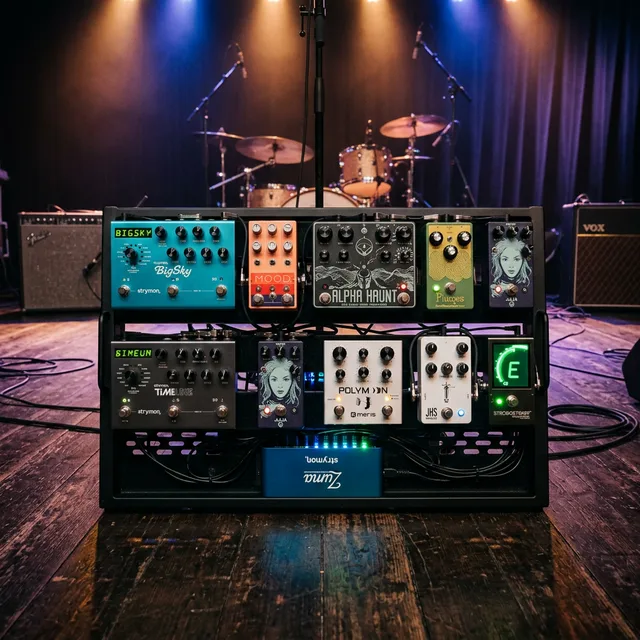
| Strymon Zuma | 5 (high current) | Yes | $250 | Power-hungry digital pedals |
| Walrus Audio Phoenix | 15 | Yes | $300 | Large boards |
For a full comparison and mounting tips, see our best pedalboards and power supplies guide.
How to Calculate Your Board’s Power Needs
Follow these steps before buying a power supply:
Step 1: List every pedal and its current draw.
Check the pedal’s manual, the label on the pedal, or the manufacturer’s website. If you cannot find the spec, 100mA is a safe estimate for most single pedals.
Step 2: Add up the total current draw.
For example:
- Tuner: 50mA
- Overdrive: 20mA
- Chorus: 60mA
- Delay: 200mA
- Reverb: 250mA
- Total: 580mA
Step 3: Add a 20% safety margin.
580mA x 1.2 = 696mA. Your power supply needs at least 700mA total output.
Step 4: Check individual output ratings.
A supply with eight 100mA outputs has 800mA total, but cannot power a pedal that draws 250mA on any single output. Make sure your highest-draw pedals have outputs that can handle them. Many supplies have one or two “high current” outputs (up to 500mA) specifically for digital pedals.
Common Power Mistakes That Damage Pedals
Using a universal adapter from a drawer. That 12V center-positive adapter from an old router will destroy a standard guitar pedal. Guitar pedals are 9V center-negative. Always verify before connecting.
Mixing up AC and DC. A pedal that requires 9V AC will be damaged by 9V DC (and vice versa). These are fundamentally different types of electrical power.
Daisy-chaining high-current digital pedals. A Strymon Timeline draws 300mA. Daisy-chaining it with other pedals on a 500mA adapter leaves very little headroom and often causes voltage sag and glitching.
Ignoring polarity on older pedals. Vintage and boutique pedals sometimes use center-positive polarity (the opposite of the standard). Pedals from the germanium fuzz era are particularly inconsistent. A $2 polarity-reversal adapter cable solves this without any risk.
Running 18V into a 9V pedal. Some players hear that running pedals at higher voltage gives “more headroom”, this is true for pedals explicitly designed for 18V operation (some MXR and Way Huge pedals). For everyone else, it just means smoke.
Troubleshooting Power-Related Pedal Noise
If your pedalboard is noisy, power is the first suspect after cables:
| Symptom | Likely Cause | Fix |
|---|---|---|
| High-pitched whine or squeal | Digital noise bleeding through shared ground | Switch to isolated supply |
| Hum that increases with more pedals | Ground loop in daisy chain | Isolated supply or star-ground wiring |
| Pedal behaves erratically | Insufficient current (voltage sag) | Use higher-current output |
| Pedal works but sounds thin | Slightly low voltage | Check adapter output with multimeter |
| Pedal does not turn on | Wrong voltage, wrong polarity, or dead output | Verify all three specs |
For a complete noise troubleshooting walkthrough, see our guide on how to reduce guitar amp hum.
Final Thoughts
Pedal power is not glamorous, but it is the foundation of a reliable, quiet pedalboard. Spend $100-200 on a proper isolated power supply and you will eliminate an entire category of noise problems while protecting your pedals from damage.
The rule is simple: always match voltage and polarity exactly, always exceed the current rating, and isolate digital from analog. Get those three things right and your board will be silent, reliable, and ready for the stage.

Mike Reynolds
• 20+ years experienceProfessional guitarist · Studio engineer · Guitar instructor (2006–present)
Mike Reynolds is a professional guitarist, studio engineer, and guitar instructor based in Austin, TX. He has recorded with regional acts across rock, blues, and country, and has been teaching private guitar lessons since 2006. Mike built his first home studio in 2008 and has since helped hundreds of students find the right gear for their budget and goals.