Best Guitar Amps for Home Practice (Wife-Approved)
You don't need a massive 100-watt full stack to practice in your bedroom. We review the best practice amps with headphone jacks, Bluetooth, and great tone.
Mike Reynolds
Professional Guitarist & Audio Engineer · 20+ years
ℹ️ Affiliate Disclosure: Music Gear Specialist earns from qualifying purchases through Amazon and other partner links. This doesn't affect our recommendations—we only suggest gear we'd use ourselves.
ℹ️ Affiliate Disclosure: Music Gear Specialist earns from qualifying purchases through Amazon and other partner links. This doesn't affect our recommendations—we only suggest gear we'd use ourselves.
The worst lie ever sold to guitarists is that you need a huge, heavy, loud amplifier to get “good tone.”
In the 1970s, you needed a massive tube amp because PA systems at venues were terrible, and the amp had to physically project sound to the back of the arena. Today, playing a 100-watt Marshall stack in your bedroom is a miserable experience. If you turn it down to “1,” the tone is thin and fizzy. If you turn it up to “3,” the police show up.
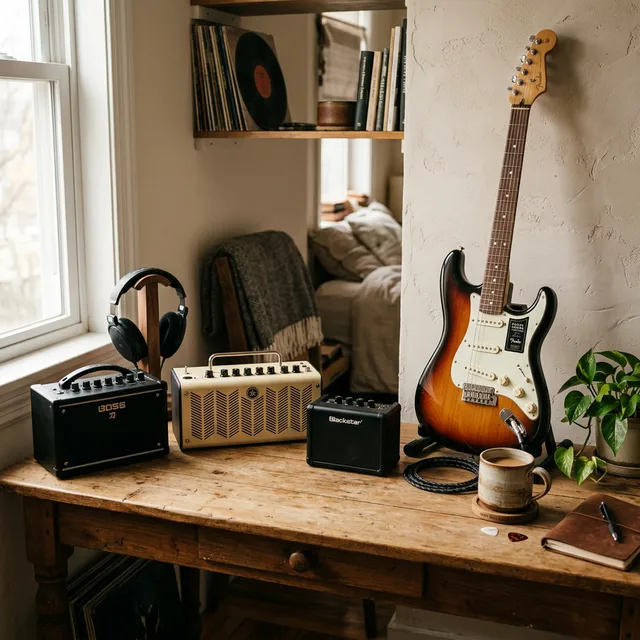
You need an amplifier designed specifically for low-volume operation. The best home practice amps of 2026 use digital modeling to provide stadium-sized tone at conversational volumes, complete with headphone outputs for midnight shredding.
Core Features of a Modern Practice Amp
Before you drop money on a combo amp, ensure it has these three modern necessities:
1. Aux In / Bluetooth Audio: You need a way to play backing tracks or Spotify through the amp so you can jam along with your favorite bands simultaneously.
2. Headphone Output with Cab-Sim: A standard headphone jack sounds harsh because it lacks the physical acoustics of a wooden speaker cabinet. Modern amps apply digital impulse responses (cab-sims) so your headphones sound like a mic’d studio amp.
3. Built-in Effects: You shouldn’t need to spend an extra $300 on delay, reverb, and overdrive pedals just to make your practice sessions enjoyable. Buy an amp with these built in.
Top Picks: Bedroom Tone Kings
1. Boss Katana 50 Gen 3 — Best Overall Value
The Boss Katana effectively killed the rest of the budget amplifier market when it launched, and the Gen 3 version remains utterly dominant. It is a 50-watt solid-state modeling amp, but it boasts a power-attenuation switch that lets you drop the output to 0.5 watts for whisper-quiet late-night playing.
Specs:
- Power: 50W (switchable to 25W and 0.5W)
- Speaker: 1x12” Custom
- Effects: 60+ Boss effects built-in
Pros: Unmatched tonal versatility. You get legendary Boss pedal algorithms built-in. It can actually get loud enough to jam with a drummer if you ever leave the bedroom. Cons: To unlock all the effects and parameters, you have to connect it to a computer via USB, which frustrates players who hate menu-diving.
2. Yamaha THR10II — Best “Desktop” Amp
If you live in a tiny apartment, or want an amp that sits proudly on your living room bookshelf instead of looking like a black carpeted box, the Yamaha THR series is the gold standard. Nicknamed the “third amp” (after your gigging amp and your studio amp), it uses an entirely different acoustic philosophy.
Specs:
- Power: 20W (Stereo 10W + 10W)
- Speaker: 2x 3.1” Full Range Custom Speakers
- Connectivity: Bluetooth audio and app editing
Pros: It fills incredibly realistic, 3D room sound at extremely shockingly low volumes. Aesthetically beautiful retro design with glowing orange internal LEDs. Built-in wireless receiver capability (with optional transmitter). Cons: Very expensive for its wattage. Will not keep up with a heavy-hitting drummer for band practice.
3. Fender Mustang Micro — Best Headphone Amplifier
What if you don’t want an amplifier speaker at all? The Fender Mustang Micro is a tiny dongle that plugs directly into your guitar’s output jack. You plug your wired headphones directly into the dongle.
Specs:
- Form Factor: Pocket-sized dongle
- Battery: Rechargeable USB-C (4 hours play time)
- Connectivity: Bluetooth audio streaming in
Pros: The ultimate portable practice rig. Stream Spotify from your phone to the dongle via Bluetooth, plug in your headphones, and you are jamming silently on the couch. Offers 12 classic amp models and 12 effects. Cons: Strictly for headphones or recording via USB. No built-in speaker. Battery life degrades over several years.
Tube vs. Digital: Does It Matter for Practice?
A massive debate online centers around whether beginners should buy “real” tube amplifiers or stick to digital modeling amps (like the Katana and Yamaha).
The Tube Argument: Tube amps react organically to your picking dynamics. If you pick softly, they stay clean; if you pick hard, they distort beautifully. Purists argue this teaches you critical right-hand dynamic control.
The Reality for Home Use: Tube amps are useless for the bedroom. A tube amp achieves that beautiful overdrive by being pushed to its volumetric limit (known as “cooking the tubes”). A 15-watt Fender Blues Junior must be cranked to deafening levels to achieve its famous tone.
For 95% of home players, digital modeling is superior. Modeling processors analyze the wave mechanics of tube distortion and replicate it algorithmically at any volume. You can get the snarling sound of a cranked Marshall stack at a volume lower than your television.
How to Get the Most Out of Your Practice Sessions
Once you purchase your practice amp, the next step is actually using it effectively.
1. Create “Presets” for Your Routine: If your amp has preset slots, set one to a pristine clean tone with heavy reverb (for practicing jazz and scales), one to a mid-gain crunch (for blues), and one extremely heavy high-gain tone (for metal riffs). Having these on speed-dial prevents you from wasting 20 minutes tone-chasing instead of practicing.
2. Use a Looper Pedal: Some practice amps include built-in loopers. If not, buy a $50 basic looper pedal. This device records what you play and loops it infinitely. You can record a simple four-chord progression and immediately practice soloing over yourself. It is the single fastest way to improve your lead playing.
3. Leave It Plugged In: Just like the advice with acoustic guitars on stands, friction kills practice. If your amp is always plugged into the wall, the guitar cable is draped over it, and your guitar is on a stand right next to it, you can start playing literally four seconds after the urge strikes.
Related Reading

Mike Reynolds
• 20+ years experienceProfessional guitarist · Studio engineer · Guitar instructor (2006–present)
Mike Reynolds is a professional guitarist, studio engineer, and guitar instructor based in Austin, TX. He has recorded with regional acts across rock, blues, and country, and has been teaching private guitar lessons since 2006. Mike built his first home studio in 2008 and has since helped hundreds of students find the right gear for their budget and goals.